

trading-education | 13-02-26
Starting prop trading involves passing a performance evaluation by reaching an 8–10% profit target while adhering to strict risk-management parameters. By paying a fee for access to institutional-scale capital, traders can earn significant profit splits without risking their personal savings. Success depends on utilizing a "capital-preservation" mindset, where you treat the drawdown limit—rather than the total balance—as your tradable equity.
The "True" Account Size: Managing the Buffer In 2026, professional traders treat the Maximum Drawdown as their actual account balance. If you are trading a $100,000 account with a $3,000 drawdown, your "usable equity" is $3,000, not $100,000.
- Risk per Trade: To survive the 2026 "math gauntlet," limit risk to 0.25%–0.5% of your drawdown buffer.
- Safety Net Rule: Many top-tier firms (like Apex) now use a "Safety Net" threshold. For a $50,000 account, once you reach a certain profit (e.g., $52,600), the trailing drawdown often stops moving, effectively converting your account into a Static Drawdown model.
- Expert Verdict: Prop trading is a high-reward, scalable tool that tests your market discipline. While it is not a guaranteed salary, it provides a direct path to professional-grade liquidity for a fraction of the traditional cost.
I have spent years navigating the landscape of proprietary trading, watching the industry shift from elite floor-trading firms to the current "retail prop" boom. When I first looked at these modern challenges, I realized they aren't just about trading—they are about navigating a specific mathematical gauntlet designed to test your discipline under extreme constraints. To start prop trading correctly, you must look past the flashy advertisements and understand the hard mechanics of the evaluation phase.
To start prop trading in 2026, you must purchase an evaluation challenge from a reputable firm, typically costing $100–$600. Traders must reach a specific profit target (usually 8–10%) without breaching daily loss limits or maximum trailing drawdowns. Success is achieved by treating the drawdown buffer as your actual tradable capital rather than the total account balance.
How to Start Prop Trading?
To start prop trading, a trader must pass a multi-stage evaluation by hitting an 8–10% profit target within a demo environment. After paying an evaluation fee (typically $100–$600), you receive access to broker-issued simulated capital. Success requires adhering to strict daily and total drawdown limits, usually capped at 5% and 10% respectively. Your ability to move to a funded status depends on risk management and consistency rule compliance.
When I sign up for a new challenge, I don't look at the $100,000 buying power. I immediately look at the Funded Account Challenge Strategy required to protect the "drawdown buffer." In most cases, you are essentially buying an "option" on a funded account. You pay a non-refundable fee ($100 to $500), and you are given a set of parameters. If you hit the Evaluation Phase Profit Target (usually 10%) before you hit the Prop Firm Drawdown Rules, you move to the funded stage.
What are the primary risk safeguards in a prop firm evaluation?
Prop firm risk safeguards are automated equity thresholds designed to protect the firm’s liquidity while vetting a trader's discipline. These include the daily loss limit (typically 4–5% of starting equity), the maximum total drawdown, and consistency rules that prevent over-leveraging on a single trade. While breaching these parameters results in account closure, they serve as the structural boundaries that define a successful, professional-grade trading strategy.
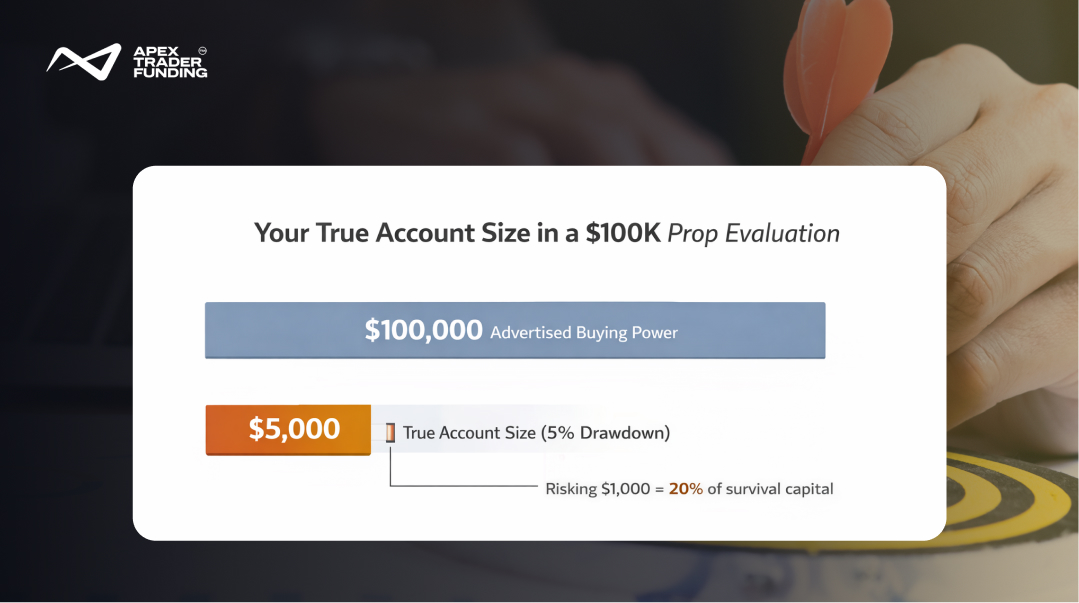
If the firm sets a 5% total drawdown on a $100k account, your "True Account Size" is $5,000. If you risk 1% of the $100,000 ($1,000) on a single trade, you aren't risking 1%—you are risking 20% of your survival capital.
"I thought I was doing great being up 4%, but then a single volatile news event wiped out my daily limit. The account was closed instantly. I didn't realize that the spread widening during the news would hit my drawdown even if the price didn't technically touch my stop loss."
The Reality of "Return on Risk"
When a firm asks you to make $10,000 in profit while only allowing a $10,000 drawdown, they are asking for a 100% return on your usable capital. This forces aggressive behavior. I've found that the "silent cost" often comes from simulated liquidity; since these are demo environments, fees like "swaps" are still deducted. If you hold a losing trade over a Wednesday night, the triple swap fee can push your balance past the daily limit, failing you while you sleep.
Drawdown Mechanics: Trailing vs. Static vs. EOD
Understanding your firm's specific drawdown logic is critical. In 2026, there are three dominant models:
Navigating the Consistency Rule (30%–50%)
The #1 reason for payout denials in 2026 is the Consistency Rule. While firms like Topstep allow a single day to equal 50% of your profits, strict firms like Apex Trader Funding enforce a 30% cap. This rule ensures that no single "windfall" trade accounts for the majority of your total profit at the time of a withdrawal.
The Payout Formula (Apex 30% Example):

If you hit a "home run" and make $3,000 in one day on a $100,000 account, you cannot withdraw until your total profit is at least $10,000 ($3,000 ÷ 0.30). If your total profit is only $6,000, you must continue trading with smaller positions to "dilute" that big win until it falls under the 30% threshold.
The 2026 "Hard Breach" Checklist
Before placing your first trade, verify these "Critical Compliance Checks" in your firm's fine print:
- 30% Negative P&L (MAE) Rule: Some firms (notably Apex) now disqualify you if an open trade's floating loss exceeds 30% of your current profit balance, even if it hasn't hit your stop loss. Example: If you have $2,000 in accrued profit, you cannot let a single trade drawdown more than $600 (-30%), or you will fail instantly.
- News Trading Restrictions: Verify if your firm allows holding positions through high-impact events like the FOMC or CPI. In 2026, some firms implement a "2-minute window" (2 minutes before and after the release) where any profits made are voided or the account is breached.
- Inconsistent Sizing: Drastic changes in contract size (e.g., jumping from 1 Micro to 10 Standard contracts in a single session) can be flagged as "gambling behavior" and lead to payout denial during the audit phase.
Core Rules and Operational Limits
To navigate these platforms, you need to understand the structural boundaries. Below is a breakdown of the standard mechanics I've observed across the top-tier firms.
How is the trailing drawdown vs. the static drawdown explained?
A static drawdown is a fixed loss floor that remains at a specific dollar amount, providing a consistent risk buffer. In contrast, a trailing drawdown "ratchets" upward as your account equity grows, locking in the firm's safety and reducing your usable risk capital even after profitable trades. While static models are more trader-friendly, trailing models are common in high-leverage futures and retail forex prop firms.
Trailing Drawdown vs. Static Drawdown: Key Differences
A static drawdown is a fixed loss floor set at a specific dollar amount. A trailing drawdown is a dynamic threshold that ratchets upward as your account equity hits new peaks. In 2026 markets, static drawdowns are preferred for swing traders, while trailing models are the industry standard for high-leverage futures evaluations.
I prefer static drawdowns, but they are becoming rare. In a trailing scenario, if you grow your $100,000 account to $105,000, your drawdown floor might move from $92,000 up to $97,000. If you then lose that $5,000 profit, your balance is back to $100,000, but your floor stays at $97,000. You now only have $3,000 of breathing room left. This is a "ratchet" that only tightens, never loosens. To navigate this effectively, it is necessary to treat the trailing floor as a dynamic risk-management tool, proactively adjusting position sizes to lock in gains and maintain a sustainable equity cushion as the account scales.
Is the prop firm model a "Risk/Reward" reality?
The prop firm model offers a high risk-to-reward ratio by allowing traders to access large capital amounts for a small upfront fee. However, the reality is a high-variance environment where the "true" risk is the loss of the evaluation fee and the "reward" is contingent on passing a rigorous math-based gauntlet. For skilled traders, it serves as a powerful scaling tool; for the undisciplined, it often results in a cycle of reset fees.
The marketing suggests you can trade with "no risk to your own capital," but your capital is the evaluation fee. If you fail, that money is gone. I have noticed a "Reset Churn" where firms incentivize you to trade aggressively to pass quickly. Aggression leads to variance, variance leads to breaches, and breaches lead to more "Reset Fees." This is often a primary revenue stream for the firm.
My Expert Insight on the "Buffer Builder"
When I start an evaluation, I ignore the $100,000 number entirely. I treat it as a $5,000 account. My strategy is to risk exactly 0.5% of that $5,000 ($25) per trade. It feels agonizingly slow, but my goal is to build a "Safety Buffer" of $2,000 in profit first. Once that buffer exists, I am trading with the firm's money, and only then do I increase my position size to hit the final target. Most traders try to hit a home run on Day 1; I try to survive to Day 10.
While many retail firms utilize MetaTrader 5 (MT5) or cTrader, traders focused on the Futures markets typically require high-performance connections via Rithmic or Tradovate. I personally use NinjaTrader for its advanced order flow visualization and automated trailing stop features, which are critical for navigating the 'ratchet' of a trailing drawdown in real-time. For those preferring modern web interfaces, TradingView integration via DXTrade remains the gold standard for charting precision across both Forex and CFD instruments.
- The catch: Many firms employ "Hidden Rules" like the Prop firm consistency rule calculator, which can disqualify you if a single trade makes up more than 30% of your total profit. Even if you hit the target, they may label it "gambling behavior" and deny the payout.
Summary of Starting Steps
Starting prop trading is a lesson in discipline. You aren't just fighting the market; you are fighting a set of rules designed to exploit human impatience.
- Treat the Drawdown as Zero: If your limit is $95,000, then $95,000 is your “zero.”
- Build a "Buffer" First: Spend your first 5 days making small, consistent gains to move your account away from the "failure floor."
- Audit Your Consistency: Use a consistency calculator weekly to ensure your best day isn't blocking your future payout.
Don’t let restrictive account parameters stand in your way when you can avoid the daily loss limit and trade with a firm that prides itself on having no hidden rules.
Risk Disclosure: Proprietary trading involves significant financial risk and is not suitable for all investors. The "funded accounts" described herein are typically simulated trading environments utilizing demo capital. Any "payouts" earned are performance-based bonuses derived from simulated profit-splits, not a guaranteed salary or investment return. Past performance in a prop firm evaluation is not indicative of future results. Please consult with a qualified financial advisor before paying any evaluation fees.
FAQs
Prop trading is profitable for a small minority of disciplined traders, with success rates for receiving a payout typically ranging from 4% to 7% across the industry. Professional institutional traders benefit from centralized pricing and fixed salaries at elite desks, while retail prop traders utilize broker-issued demo accounts to access high-leverage simulated capital. While most participants fail due to strict drawdown rules and evaluation fees, top performers earn five-to-six-figure annual profit splits. Whether you succeed depends on your risk management discipline and the specific payout reliability of your chosen firm.
To start a prop firm, you typically need between $25,000 and $50,000 for a lean white-label launch, though institutional setups often require over $500,000. White-label models allow founders to lease pre-built technology stacks and risk management dashboards for a lower upfront cost, while main-label solutions offer full control over broker-issued infrastructure and proprietary software but demand significant capital for licensing and development. Beyond technology, you must budget for legal compliance, payout reserves, and marketing to build a sustainable trader funnel. Which model you choose depends on your technical expertise and the total capital available for operational runway.
Related Blogs
trading-education | 22-08-25
What is a Funded Trading Account? - Detailed Guide
A funded trading account is a financial arrangement where a proprietary trading firm (like Apex) provides you with virtual or...
Read more
trading-education | 23-08-25
How Do Funded Trading Accounts Work?
A funded trading account works by granting a trader access to a firm's capital after they pass a simulated evaluation....
Read more
trading-education | 25-08-25
How to Get Funds for Trading? - 6 Practical Ways
Starting a trading journey often requires more than knowledge—it requires capital. Yet many aspiring traders face the same challenge: how...
Read more