


trading-education | 27-01-26
The best futures trading books for 2026 focus on Auction Market Theory and professional risk management. "Mind Over Markets" is the gold standard for market logic, while "Trading Price Action Trends" provides the technical depth required for E-mini S&P 500 scalping. For mindset, "Trading in the Zone" remains the essential guide for developing a probabilistic execution framework.
- Best for Market Logic: Mind Over Markets – The "Gray's Anatomy" of auction theory; essential for understanding why price moves.
- Best for Technical Tactics: Trading Price Action Trends – A dense, exhaustive manual for scalping the E-mini S&P 500 bar-by-bar.
- Best for Psychology: Trading in the Zone – The definitive guide to fixing the fear and greed that sabotage profitable strategies.
- Best Comprehensive Reference: A Complete Guide to the Futures Market – The industry standard encyclopedia for contract specs, spreads, and risk.
- Best for Professional Reality: Market Wizards – Invaluable interviews that reveal how top traders actually manage risk and drawdowns.
In my experience, I have seen hundreds of aspiring traders cycle through expensive courses and signal rooms, only to fail because they lacked foundational knowledge. The reality of the futures market is that no PDF cheat sheet can replace a deep understanding of auction mechanics and risk.
Most "best futures trading books" lists are filled with generic titles that promise easy income. The books I have selected for this audit are different. These are the texts we actually keep on the desk—the ones that are dense, difficult, and devoid of hype. Whether you are looking for price action trading books to refine your entries or trading psychology books to stop self-sabotage, these resources provide the frameworks required to survive in an electronic, algo-driven environment.
Quick Comparison: Top Picks at a Glance
Metric-to-Book Mapping: Diagnose Your Equity Curve
In 2026, professional traders use their Journal Metrics to determine their study path. Use this table to match your specific technical failure to the correct literature.
If your Journal shows... | Read this Book: | Biological Focus: |
|---|---|---|
High MAE (holding losers) | Best Loser Wins | Loss Aversion / Ego |
Flat Equity (overtrading) | Mind Over Markets | Market Selectivity |
Low Profit Factor (hesitation) | Trading in the Zone | Probabilistic Mindset |
High Slippage (bad entries) | Price Action Trends | Order Flow Timing |
Detailed Breakdown of Top Choices
1. Mind Over Markets (James Dalton)

Specs:
- Difficulty: ⭐⭐⭐⭐☆ (4.4/5)
- Core Concept: Auction Market Theory (AMT) & Market Profile.
- Key Lesson: Distinguishing "Initiative" vs. "Responsive" activity.
- Era: Post-pit, Pre-HFT (Concepts remain timeless).
Mind Over Markets is not a book you read for entertainment; it is a framework you study to understand the intent behind price movement. In my experience, this is the "Gray's Anatomy" of our industry. Dalton forces you to stop viewing the market as a linear line on a chart and start seeing it as a mechanism for advertising value.
The Core Concept: Dalton uses the Market Profile, which organizes price data into a bell curve distribution to identify where "fair value" is established versus where price is unfair (cheap or expensive).
When I first studied this, the concept of the "Bell Curve" distribution of volume changed how I traded. Dalton teaches you that roughly 70% of trades happen in a "Value Area" (the center of the curve).
Why It Matters Most beginners chase price. Dalton teaches you to:
- Wait for the price to move away from the "Value Area."
- Trade it back toward the mean (Responsive).
- Identify when value shifts to a new level (Initiative).
Expert Insight:
I treat this book as a filter for market conditions. Before I look for a trade, I use Dalton's logic to determine the "Day Type" (e.g., Trend Day vs. Normal Variation). If the market is in a tight balance, I know not to chase breakouts. This saves me from getting chopped up in the noise.
- Case Study: It is incredibly dense. The detailed anecdotes about specific trading days in the late 80s can be tedious, and you will need to mentally translate "pit noise" to modern tools like the DOM or Delta.
2. Trading Price Action Trends (Al Brooks)

Al Brooks’s "Trading Price Action Trends" is an exhaustive technical manual for bar-by-bar price action analysis. It is designed for traders who want to master the E-mini S&P 500 without relying on lagging indicators. Brooks focuses on "MFE" (Maximum Favorable Excursion) by teaching traders how to hold winning trades through minor pullbacks.Specs:
- ⭐⭐⭐⭐ (4.1/5) –
- Core Concept: Bar-by-bar analysis of the 5-minute chart.
- Key Lesson: Reading buying/selling pressure via candle overlap.
- Era: Electronic Era (E-mini S&P 500 focused).
If Dalton is the philosopher, Al Brooks is the engineer. Trading Price Action Trends is likely the most exhaustive technical manual ever written for the E-mini S&P 500. Brooks breaks down every single tick of a 5-minute candle to determine who is in control.
I find this book to be a double-edged sword. It contains high-value technical truth—specifically regarding H1/L1 signals and counting legs in a pullback—but the density is punishing. It reads like a VCR manual.
Style Sample (Warning):
"Bar 4 was a bear reversal bar... huge L2 short signal... The market became a two-sided trading range. Bulls bought the close of bar 6, bears sold the high of bar 7."
Brooks proves that you don't need indicators to trade; you just need to understand price action context. However, his assumption that you can trade effectively with a naked chart minimizes the modern impact of HFT noise, which I find requires more nuance today than in 2011.
- The catch: Boredom is the enemy here. Brooks repeats concepts for 400 pages. Many traders buy the book but eventually pay for his video course just to hear a human explain what he wrote.
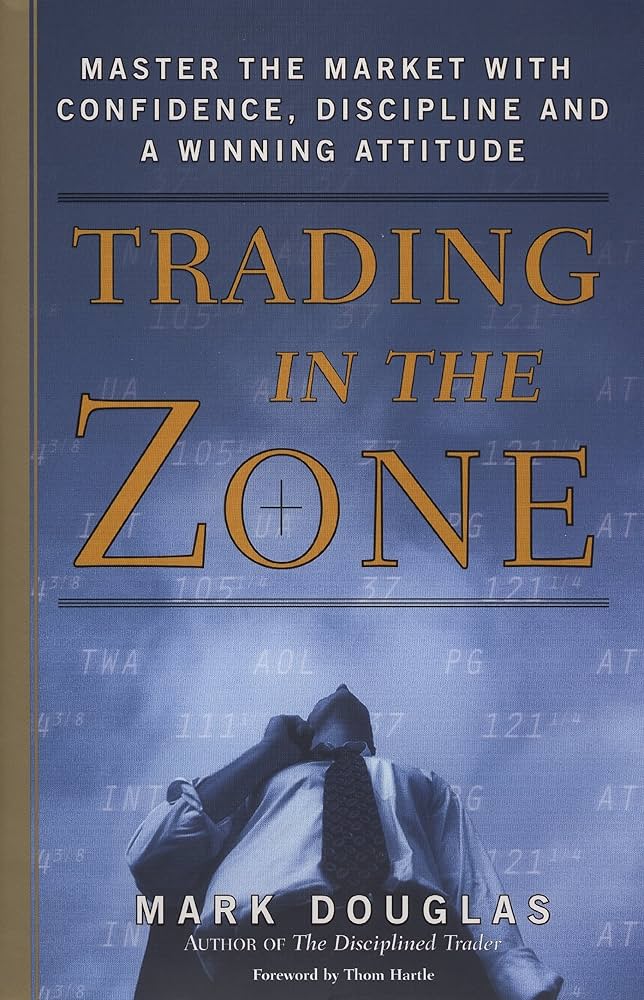
3. Trading in the Zone (Mark Douglas)
Specs:
- ⭐⭐⭐⭐☆ (4.4/5)
- Core Concept: Thinking in Probabilities.
- Key Lesson: The "20-Trade Exercise."
- Era: Timeless (Human Psychology).
Mark Douglas’s Trading in the Zone is the industry standard for repairing trader psychology and eliminating emotional bias. It focuses on the "Five Fundamental Truths" of trading, training the mind to accept randomness and execute an edge over a 20-trade sample without hesitation. It is critical for overcoming "loss aversion" and "fear of missing out" (FOMO).
When I blew up my first account, this is the book that helped me rebuild. Douglas explains that an "edge" is simply a higher probability of one thing happening over another, and that you do not need to know what will happen next to make money. His "20-Trade Exercise"—where you take 20 trades without emotion to prove your edge—is a drill I still recommend to every junior trader I mentor.
- The catch: The first few chapters on "Fundamental Analysis" are weak. Skip them and start at Chapter 4. Also, this book is often useless to beginners; you usually need to feel the pain of a significant loss before Douglas's words resonate.
4. A Complete Guide to the Futures Market (Jack Schwager)
Specs:

- ⭐⭐⭐⭐☆ (4/5)
- Core Concept: Encyclopedia of futures mechanics.
- Key Lesson: Fundamental analysis and spread trading.
- Era: Pre-HFT but structurally accurate.
Jack Schwager is best known for Market Wizards, but this text is his technical masterpiece. It serves as a one-stop reference for how futures markets actually work. Unlike the actionable strategy of Brooks or Dalton, this book provides the structural knowledge of contract specs, margin math, and spread logic.
I keep this on my shelf as a reference. While the specific chart examples are dated (often daily bars that are too slow for modern scalping), the chapters on risk management and systems evaluation are timeless. It teaches you the "physics" of the market—how leverage works and why spreads move—which is critical for moving beyond simple directional betting.
- The catch: It is heavy and academic. Do not expect a "plug-and-play" system. It gives you the ingredients, not the recipe.
5. Market Wizards (Jack Schwager)

"Market Wizards" is a collection of interviews with world-class traders that highlights the importance of risk control over "perfect" entries. In 2026, this text is vital for prop firm traders to understand the "30% Consistency Rule"—Schwager’s subjects prove that long-term success isn't about one windfall day, but staying within a stable safety buffer.
Specs:
- ⭐⭐⭐⭐☆ (4.3/5)
- Core Concept: Interviews with top traders.
- Key Lesson: There is no "one way" to trade.
- Era: Late 80s/Early 90s (Principles apply).
Market Wizards is essential because it shatters the retail fantasy of a "Holy Grail." By interviewing traders who use vastly different methodologies—from pit scalpers to long-term trend followers—Schwager proves that success comes from risk control, not a magic indicator.
I value this book for the "skin in the game" reality check. It shows that even elite traders have long flat periods and massive drawdowns. It focuses on how pros behave rather than exactly where they enter, which is the missing link for most struggling traders.
- The catch: It offers almost zero step-by-step systems. If you want to know exactly when to click "buy," this book will frustrate you.
6. Trading Commodities and Financial Futures (George Kleinman)

Specs:
- ⭐⭐⭐⭐☆ (3.9/5)
- Core Concept: Practical mechanics and seasonality.
- Key Lesson: Order types and trend following.
- Era: Updated for electronic markets.
George Kleinman offers a middle ground between the academic density of Schwager and the intense technicals of Brooks. This book is strong on actionable mechanics—explaining order types, seasonality, and basic setups.
However, I find the advice on seasonal patterns to be dangerous in the modern era if followed blindly. In the current data-mined market, naive seasonality is often front-run by algorithms. While the risk management ideas are solid, the specific setups need to be rigorously backtested before being applied to a live account in 2024.
- The catch: Some examples imply that simple moving-average crossovers are a durable edge. In today's efficient market, relying solely on these basic signals is a recipe for drawdown.
7. Options, Futures, and Other Derivatives (John C. Hull)

Specs:
- ⭐⭐⭐⭐☆ (4.2/5)
- Core Concept: Mathematical pricing models.
- Key Lesson: Arbitrage and hedging.
- Era: Modern Academic Standard.
This is the university standard for quantitative finance. It is not a trading manual; it is a physics textbook for finance. I include it here because it is the "source code" for how the instruments we trade are priced.
If you are a discretionary day trader, this is likely overkill. But if you want to understand the mathematical relationship between futures and spot prices, or how options pricing affects volatility, Hull is the authority. It cures you of the belief that "carry" is free money.
- The catch: It is extremely mathematical. Unless you have a background in calculus or stats, it will be unreadable. It is for structural learners, not pattern traders.
The "Decision Matrix"
Don't buy a book that solves a problem you don't have. Use this 2026 Tech-Logic matrix to select your starting point based on your current platform and failure points.
Behavioral Pattern:
"You will read Trading in the Zone three times. Once you start (and ignore it). Once, after you fail (and understand it). And once when you succeed (and master it)."
Final Thoughts
The "best" book is the one that addresses your blind spot. For most beginners, I recommend starting with Market Wizards to set realistic expectations, then moving to Mind Over Markets to build a structural framework. Leave Al Brooks for when you are ready to treat trading as an engineering problem rather than a hobby.
Remember, none of these books will work if you do not apply the "20-Trade Exercise" logic: test the concepts with small risk, prove the edge, and only then scale up.
Take the complex price action theories from these manuals and test them in a live execution environment.
FAQs
The 60/40 rule refers to the favorable tax treatment applied to regulated futures contracts under IRS Section 1256. Regardless of how long the position is held, 60% of the gains are taxed at the lower long-term capital gains rate, while the remaining 40% are taxed at the higher short-term ordinary income rate. This structure significantly benefits active traders compared to stocks, where short-term trades are taxed entirely at ordinary income rates.
$25,000 is widely considered robust starting capital for professional futures trading, offering a necessary buffer against standard market volatility. This amount allows traders to execute strategies using standard E-mini contracts with conservative leverage (under 10:1) or diversify significantly using Micro contracts to manage risk. While sufficient for intraday speculation, the viability of this amount ultimately depends on whether you plan to hold positions overnight, which triggers higher exchange-mandated maintenance margins.
Related Blogs

trading-education | 22-08-25
What is a Funded Trading Account? - Detailed Guide
A funded trading account is a financial arrangement where a proprietary trading firm (like Apex) provides you with virtual or...
Read more
trading-education | 23-08-25
How Do Funded Trading Accounts Work?
A funded trading account works by granting a trader access to a firm's capital after they pass a simulated evaluation....
Read more
trading-education | 25-08-25
How to Get Funds for Trading? - 6 Practical Ways
Starting a trading journey often requires more than knowledge—it requires capital. Yet many aspiring traders face the same challenge: how...
Read more