


trading-inspiration | 07-01-26
Best Trading Psychology Books for 2026
For probabilistic thinking, Trading in the Zone remains the gold standard. To solve systematic emotional bugs like revenge trading, The Mental Game of Trading is superior. For traders struggling with scaling winners, Best Loser Wins provides the necessary contrarian mindset. Choose your book based on your current Equity Curve failure point.
Diagnostic Map: Match Your Metrics to the Solution
Use your trading journal data to identify which psychological "bug" is currently capping your equity curve.
If your Journal shows... | Read this Book: | Biological Focus: |
|---|---|---|
High MAE (holding losers) | Best Loser Wins | Loss Aversion |
Low Profit Factor (revenge trading) | The Mental Game of Trading | Impulse Control |
Hesitation at A+ Setups | Trading in the Zone | Probabilistic Mindset |
In trading, technical skill is visible—but psychology is decisive. Many traders spend years refining indicators and strategies, only to discover that the real obstacle isn’t the chart, but their own reactions to uncertainty, loss, and pressure. Profitable traders eventually realize that markets reward emotional consistency, not emotional comfort.
“Trading skill is built on charts, but trading consistency is built in the mind.”
The best trading psychology books do not promise confidence or control. Instead, they teach acceptance, discipline, and self-awareness—the traits that allow traders to execute well even when outcomes are uncertain. The books below are widely respected because they address specific psychological failures that cause traders to sabotage otherwise sound strategies.
Choosing the Right Trading Psychology Book
Trading in the Zone – Mark Douglas (The Undisputed Foundation of Trading Psychology)
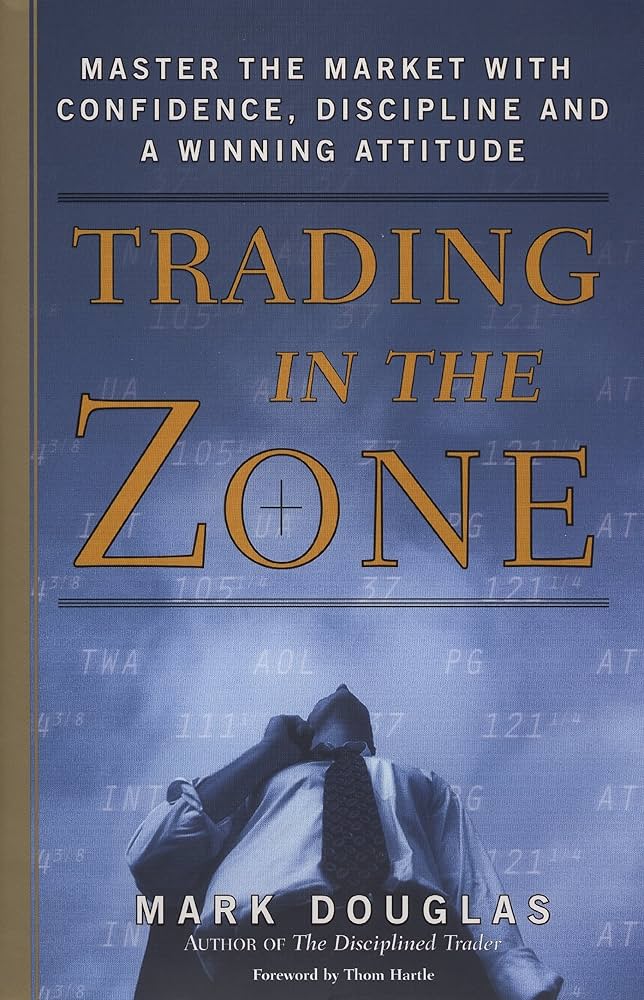
"Trading in the Zone" is the best book for developing a "probabilistic mindset," which is the ability to accept a series of losses without emotional fallout. Douglas teaches that because every trade has a random outcome, you must detach from individual results to allow your edge to play out over a large sample size.
This book reframes losses as statistical outcomes rather than personal failures. For many traders, this shift removes the Dopamine-driven Overtrading that occurs when trying to "win back" a loss. It is foundational because it reshapes how traders experience the Performance Excursion of their strategy.
Best suited for traders who:
- Struggle with fear or hesitation
- Feel emotionally affected by individual trades
- Chase certainty instead of probabilities
The Mental Game of Trading – Jared Tendler (Fixing Repeated Mistakes Systematically)

Jared Tendler’s The Mental Game of Trading is the best resource for fixing repeated execution errors. It treats emotions like "revenge trading" or "fading the move" as technical bugs. By using the "Mental Game Map," traders can categorize emotional triggers and create a "Logic Statement" to interrupt impulsive behaviors during live market sessions.
Best suited for traders who:
- Repeat the same mistakes despite experience
- Know their rules but don’t follow them under pressure
- Want a structured improvement process
Best Loser Wins – Tom Hougaard (Learning to Win by Becoming Comfortable Losing)

"Best Loser Wins" is the definitive guide for traders who struggle with "averaging down" or hitting their Trailing Threshold in prop firm environments. Hougaard argues that because the human brain is wired for comfort, traders must learn to act against their instincts by adding to winners and cutting losers with mechanical indifference.
Hougaard’s perspective is direct and often uncomfortable. He argues that most traders fail because they act like normal humans—seeking comfort, avoiding pain, and taking quick gratification. Markets punish this behavior.
The book emphasizes that successful traders learn to lose well. They accept losses quickly, stay in discomfort longer with winners, and act contrary to instinct. This makes the book inspirational in a non-motivational way; it challenges traders to rethink what “success” feels like.
Best suited for traders who:
- Take profits too early
- Hold losing trades, hoping they recover
- Struggle with emotional discomfort
The Daily Trading Coach – Brett Steenbarger (A Daily Coach for Independent Traders)

"The Daily Trading Coach" provides 101 lessons designed to turn the trader into their own psychologist. It is the best choice for independent traders who need a structured daily routine to maintain discipline and avoid the "burnout" often associated with high-frequency intraday trading.
This book functions less like a narrative and more like a personal mentor. Structured as short, targeted lessons, it allows traders to address specific psychological challenges as they arise confidence, discipline, burnout, or motivation.
Rather than offering universal advice, Steenbarger encourages traders to build around their strengths while addressing weaknesses gradually. It’s particularly effective for traders who work alone and need structure beyond charts and journals.
Best suited for traders who:
- Trade independently without feedback
- Need ongoing accountability
- Want practical exercises, not theory
Market Mind Games – Denise Shull (Understanding Risk Through Neuroscience)

"Market Mind Games" is the best book for understanding the "Neuroscience of Risk" and how the Limbic System influences decision-making. Denise Shull explains that ignoring emotions leads to "Amygdala Hijack," where the brain's fear center takes over, causing analytical traders to freeze or panic during high-volatility events.
This section on the Neuroscience of Risk explains why logic often fails under pressure. By identifying the "Physical Sensation" of a trade—the sweating palms or the rapid heartbeat—traders can recognize when their Amygdala has hijacked their prefrontal cortex, allowing them to step away before a "Performance Excursion" turns into a total account blowout.
This book helps traders integrate intuition, physical sensations, and emotional awareness into decision-making. It is especially relevant for analytical traders who believe logic alone should override emotion, yet still struggle under pressure.
Best suited for traders who:
- Are highly analytical but emotionally reactive
- Struggle to reconcile logic with feelings
- Want deeper self-awareness
Why Trading Psychology Matters More Than Strategy
Trading psychology is the primary driver of long-term profitability because it dictates whether a trader can actually execute a strategy during a "Drawdown Phase." Without a mastery of "Probability of Ruin" and emotional regulation, even the most accurate technical indicator will lead to failure due to human error.
Markets operate on probability, yet human beings are wired to seek certainty. This mismatch creates most trading errors, such as holding losers too long, cutting winners early, overtrading after losses, or hesitating at valid entries. Psychology books help traders close this gap by reshaping how they interpret risk, randomness, and performance.
Rather than motivating traders to “believe more,” these books teach them to think differently—to detach from outcomes and focus on process.
“The moment a trader focuses on execution over outcomes, psychology becomes an advantage instead of an obstacle.”
A Practical Way to Start
For most traders, psychology is not a one-time fix. It evolves as experience grows. A practical approach is to begin with Trading in the Zone to establish a probabilistic mindset. Once specific issues, like revenge trading, fear, and inconsistency appear, more targeted books like The Mental Game of Trading or Best Loser Wins become valuable.
These books don’t make trading easy. They make it honest. And for traders willing to confront themselves, that honesty becomes a lasting edge.
FAQs
The best trading psychology is one that focuses on process over outcomes, accepts uncertainty, and manages risk consistently rather than trying to be right on every trade. Successful traders think in probabilities, knowing that individual losses are part of a larger statistical edge.
Instead of reacting emotionally to wins or losses, strong trading psychology emphasizes discipline, self-awareness, and repeatable execution. Traders with this mindset judge success by how well they follow their plan, not by the result of a single trade.
Trading is not an exact percentage, but psychology plays a significant role, especially once basic strategy and risk management are understood. Many traders use similar setups, yet outcomes differ largely because of emotional control, discipline, and consistency.
As experience grows, technical skills tend to level out, while psychological factors—such as handling losses, avoiding impulsive decisions, and sticking to a plan—become the main differentiators. In that sense, trading often feels more psychological than technical over the long run.
Related Blogs

trading-inspiration | 24-08-25
Are Funded Trading Accounts Legit or a Scam?
In the last decade, a new question has captured the curiosity of traders worldwide: Can you really trade with someone else’s...
Read more
trading-inspiration | 29-08-25
Do You Have to Pay Back Funded Trading Accounts?
You are never personally liable for trading losses in a funded account because you are technically an independent contractor trading...
Read more
trading-inspiration | 05-09-25
What Happens if You Lose Money on a Funded Account?
Every trader dreams of gaining access to more capital. Funded accounts make this possible, offering a chance to trade larger...
Read more