

trading-education | 09-12-25
Many people dream of day trading because of its flexibility and financial potential. In 2026, the rise of proprietary trading firms has fundamentally changed the "Unit Economics" of entering the market. Instead of risking $50,000 of personal savings, a trader can spend roughly $150 on an evaluation fee to access $50,000 in buying power, shifting the barrier to entry from capital accumulation to skill acquisition.
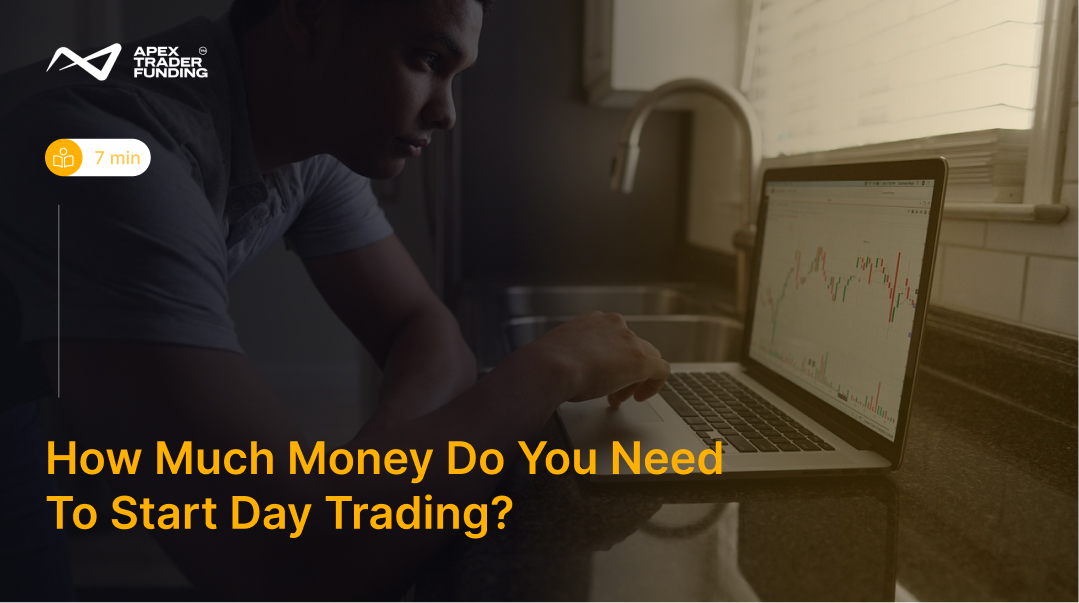
How Much Money Do You Need to Start Day Trading?
In 2026, the capital required depends on the asset class. To day trade U.S. Stocks, you need a minimum of $25,000 (PDT Rule) in a margin account. However, Futures and Forex have no PDT requirements; you can start with $50–$150 using a prop firm evaluation or $2,500–$5,000 in a personal account to safely manage Micro E-mini contract margins.
Legal Minimums vs. Realistic Minimums
This table shows the gap between “possible” and “practical.” Starting with too little capital often forces traders into emotional decisions, such as taking on oversized trades or unnecessary risk just to make progress.
“The goal isn’t to start day trading with the smallest budget, but to invest enough to learn, adapt, and keep progressing.”
Why the Market You Choose Changes the Amount You Need?
The asset you trade dictates your capital requirements through two main levers: federal regulation (like the PDT Rule) and contract exchange requirements (like CME margins). While stocks require high liquidity for day trading, Futures allow for high capital efficiency through Micro contracts that require 1/10th the margin of standard contracts.
Stock Trading and the $25,000 Rule
In the United States, anyone making more than three day trades in five days using a margin account must follow the Pattern Day Trader (PDT) rule. This law requires a minimum account balance of $25,000 at all times, or else day trading privileges are restricted.
Many experienced traders recommend $30,000 or more to create a buffer so small losses don’t drop the account below the limit.
Using T+1 Settlement to Day Trade with Small Accounts
Expert Insight: Following the 2024 shift to T+1 settlement for U.S. equities, cash accounts have become significantly more viable for small traders. If you have a $5,000 cash account, your entire balance settles the next business day. This allows you to rotate your full capital every 24 hours without triggering a Good Faith Violation, providing a flexible, PDT-free environment for beginners.
This method is ideal for traders who:
- Want to start small
- Don’t need dozens of trades per day
- Prefer avoiding regulatory restrictions
Forex and Futures: The Low-Barrier Path
Forex and futures markets do not follow the Pattern Day Trader (PDT) rule, and many brokers allow traders to open accounts with relatively small amounts — sometimes as low as $50. However, extremely small balances tend to push beginners into high leverage and risky behavior.
To trade responsibly with proper position sizing, most new traders need at least:
- $1,000–$2,000 for forex
- $1,000–$2,000 for futures (depending on contract size and volatility)
Starting with this level of capital provides a healthier buffer, reduces emotional pressure, and allows traders to manage risk without resorting to oversized leverage.
Futures: The Path of Micro Contracts (MES/MNQ)
In 2026, the "Micro" revolution is the standard for new traders. CME Micro E-mini S&P 500 (MES) and Micro Nasdaq-100 (MNQ) contracts only require roughly $50–$100 in intraday margin per contract. This 1/10th sizing allows you to trade with a $2,000 account while keeping your risk-per-trade at a professional 1–2% level.
Costs Beyond Your Trading Capital: A 2026 Audit
Trading expenses in 2026 extend beyond your broker balance into "Semantic Entities" like data feeds and platform licenses. To trade effectively, you must budget for specific exchange fees that ensure you are seeing "Real-Time" rather than "Delayed" prices.
Monthly Data Fee Comparison
“Successful day traders don’t start with the most money—they start with the smartest plan.”
The Emotional Cost — Why Starting Too Small Hurts Traders
Starting with too little capital often leads to predictable problems:
- Taking oversized trades to “make it worth it”
- Panicking after small losses
- Overtrading because buying power is limited
- Getting discouraged after minor drawdowns
This is why experts say your first $1,000–$5,000 in trading often becomes “tuition” — the amount you effectively pay to learn the skill.
Small accounts are possible, but larger accounts are emotionally safer because each mistake doesn’t feel catastrophic.
The "Safety Net" Buffer: A Professional Requirement
In 2026, professional traders emphasize the "Withdrawal Buffer" or "Safety Net." If you are trading a $50,000 funded account, you do not withdraw your first $1,000 in profit. Instead, you keep a $2,000–$3,000 "Safety Net" in the account. This buffer ensures that a single losing streak doesn't blow your account immediately after you take a payout, preserving your long-term access to capital.
Final Thoughts
The ideal starting amount for day trading is defined by your ability to manage the Unit Economics of your chosen market. Whether you leverage the T+1 settlement of a cash stock account or the MES Micro contracts in a futures account, your success depends on having enough capital to survive the learning curve.
FAQs
Yes, you can day trade with $500, but your options will be limited. With a small account, you cannot use a margin account in the U.S. without triggering the Pattern Day Trader (PDT) rule, so you must trade through a cash account or in lower-barrier markets like forex. The main challenge is that a $500 balance leaves very little room for risk management, meaning even small losses can significantly impact your ability to continue trading. Because of this, many beginners eventually explore prop firm programs, which allow traders to access larger capital pools once they can demonstrate consistent skill.
Yes, day trading is considered a high-risk career because your income depends entirely on market conditions, personal skill, emotional control, and consistent execution. Losses can occur quickly, especially for beginners who trade without a clear plan or proper risk management. While disciplined traders can build a sustainable path over time, the profession lacks guaranteed income, benefits, or job security, making it much riskier than traditional careers.
Related Blogs
trading-education | 22-08-25
What is a Funded Trading Account? - Detailed Guide
A funded trading account is a financial arrangement where a proprietary trading firm (like Apex) provides you with virtual or...
Read more
trading-education | 23-08-25
How Do Funded Trading Accounts Work?
A funded trading account works by granting a trader access to a firm's capital after they pass a simulated evaluation....
Read more
trading-education | 25-08-25
How to Get Funds for Trading? - 6 Practical Ways
Starting a trading journey often requires more than knowledge—it requires capital. Yet many aspiring traders face the same challenge: how...
Read more